
I’ve spent the last couple of weeks doing something a little unhinged: reading six different studies on how ChatGPT’s fan-out queries work, cross-checking their numbers against each other, and trying to figure out which parts actually hold up. My trigger was Lily Ray’s piece on the topic, which is worth reading and which I’ll cite a few times here. But I walked away from the underlying research with a different read on what’s actually going on, and I think it’s the more useful one if you’re trying to decide what to do about it.
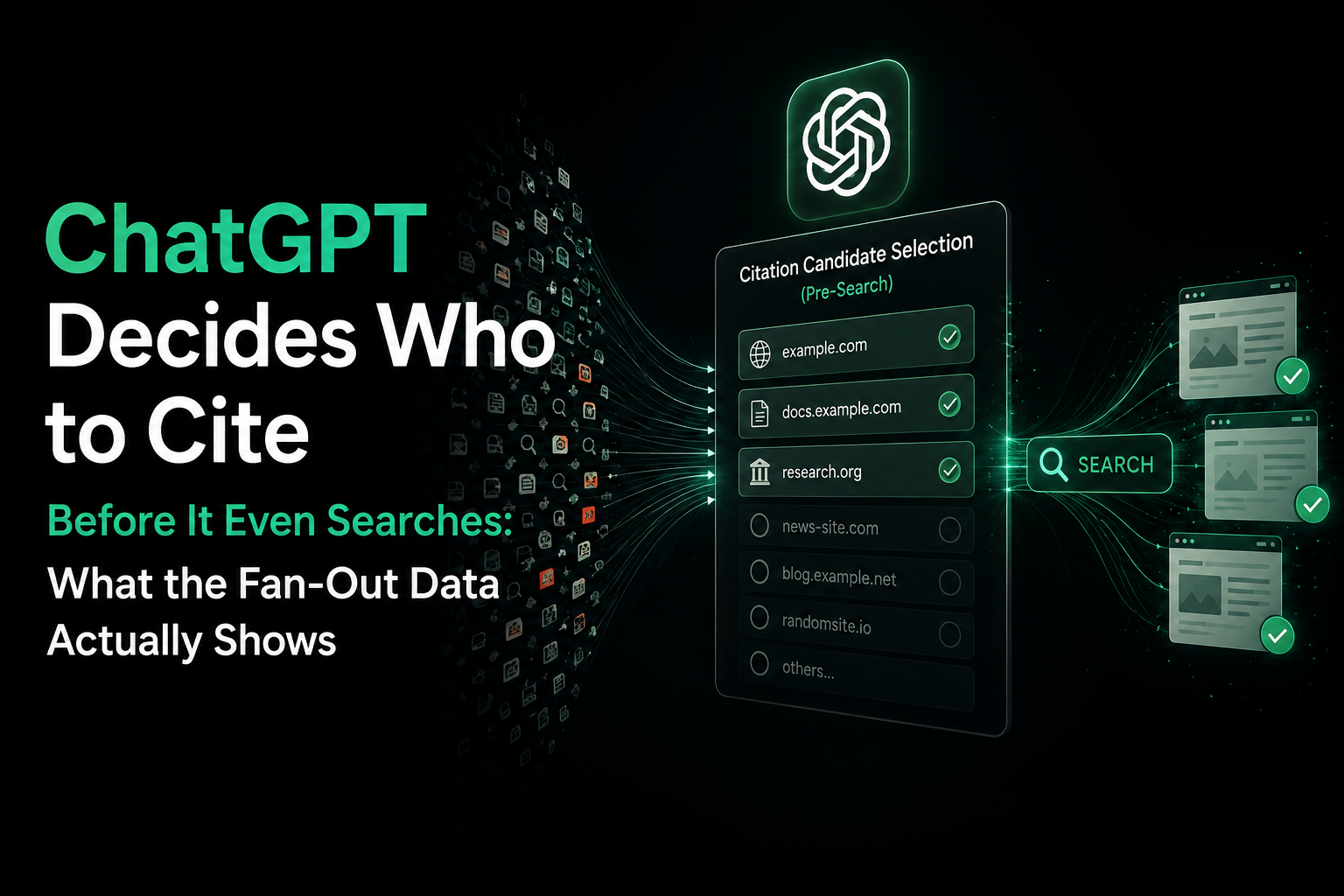
Here’s my TL;DR before I make you read the whole thing: the site: operator everyone’s talking about is a symptom, not the mechanism. The real story is that ChatGPT appears to decide which brands matter for a query before it runs a single search, and once that decision is made, ranking well on Google barely moves the needle on whether you get cited. That’s a much scarier finding for most SEOs than “add site: search operators to your mental model,” and I don’t think it’s getting enough attention.
Key Takeaways
- Brands ChatGPT names in its own first search query get cited 68.9% of the time. Brands it merely retrieves, without naming, get cited 2.1% of the time (Suganthan Mohanadasan, August 2026).
- 60% of ChatGPT’s cited sources don’t rank in the top 10 of Google or Bing for the queries that surfaced them (Grow & Convert, March 2026).
- The
site:operator now shows up in roughly 64% of fan-out queries, up from a rounding error a year ago (Nectiv, August 2026).- Reddit gets retrieved as a candidate source in 76% of OpenAI’s searches and gets cited 0.61% of the time it’s offered, yet still tops the citation leaderboard because of sheer volume (Dejan.ai, 2026).
- Domain-level authority correlates with citation far more than individual page rank (50% vs. 27%), which tells you where to spend effort.
Retrieved and cited are not the same thing, and mixing them up will get you the wrong strategy
Quick definitions, because half the confusion in this space comes from people using these two words interchangeably. Retrieved means ChatGPT fetched a page while running its background searches. Cited means the page actually made it into the answer as a visible link. A page can get retrieved constantly and cited almost never, and as you’ll see with Reddit, that gap is enormous.
When ChatGPT gets a question it can’t answer from training data alone, it breaks your prompt into a handful of its own searches (the “fan-out”), runs them, reads what comes back, and writes an answer from whatever survives the cut. Suganthan Mohanadasan pulled this apart using OpenAI’s API, which exposes both the retrieved candidates and the final citations, across 57 conversations and 3,554 retrieved pages. Only 110 of those pages made it into an actual answer. That’s a 3.1% survival rate.
That 96.9% drop-off is the number I keep coming back to. If you’re tracking “brand mentions in ChatGPT’s search queries” as a visibility metric (a lot of GEO tools do exactly this), you’re measuring the top of a funnel that loses almost everything before it reaches the reader. It’s not a useless metric, but it’s an early one, and treating it as the finish line will make your reporting look a lot rosier than your actual citation count.
The site: operator boom is real, but it’s not the interesting part
Now to the thing everyone’s actually talking about. Chris Long at Nectiv ran roughly 4,000 prompts against ChatGPT 5.6 Sol and compared them to his 2025 baseline. Average fan-out queries per prompt went from 2.17 to 7.61. The longest chain he observed went from 4 searches to 29. And site: showed up in 64% of all fan-out queries, alongside “official” and “gov” as the two other words the model adds most often that you never typed yourself.
Tomek Rudzki at Peec AI ran a much bigger study, 5 million fanout queries across ChatGPT, Perplexity, and Grok collected in April 2026, and found something that doesn’t match Nectiv’s numbers at all: ChatGPT averaging 2.1 fanouts per query, not 7.61, with “best,” “what,” and “review” as the top injected words rather than site:. Two credible datasets, same time window, wildly different conclusions.
I don’t think either study is wrong, exactly. Nectiv pulled fan-outs through OpenAI’s API on the current default model. Peec AI’s dataset spans three platforms and a slightly earlier window, and averages in a lot of queries that never needed a deep search chain to begin with. This is the least sexy but most important lesson in this whole space: two people can watch the same model in the same month and report numbers that look nothing alike, because “how you counted” changes the answer as much as “what the model did.” Read the methodology section of any fan-out study before you repeat its headline number. I mean that as a general rule, not just about these two.
What both studies agree on, and what I think actually matters, is the direction. More searches, longer chains, and a much heavier lean on site:, “official,” and “gov” as scoping words. Whatever ChatGPT is doing differently now, it’s doing more of it, and it’s doing it more precisely.
The part nobody’s talking about enough: ChatGPT already picked its favorites
Here’s where I think the conversation needs to move. Suganthan’s data shows that in 21 of 27 conversations he tested, the model’s very first search query already contained brand names the user never typed. Ask ChatGPT about “the best AI note-taking app” and its first background search might already read something like Granola vs Notion AI vs Otter vs Fireflies, before it has retrieved a single page.
That reads less like a search and more like a recall test, one where the model already knows the answer it’s looking to confirm.
And the citation gap that follows is the real headline, more than anything about site: searches. Brands the model names itself in that first query get cited 68.9% of the time. Brands that only show up later, retrieved but never named by the model, get cited 2.1% of the time.
To be fair to the data, this is one account, sampled over two days in July, weighted toward software categories, which the author himself flags as a limitation. I’d want to see this replicated across accounts and verticals before I treat 68.9% and 2.1% as gospel numbers. But directionally, it lines up with everything else in this article: whichever brands are already lodged in the model’s head win, and everyone else is fighting over the scraps left in the “retrieved but not cited” pile.
Ranking on Google matters less for AI citations than most of us assumed
If ChatGPT is deciding brands ahead of time and scoping searches with site:, you might reasonably assume it’s still ultimately grabbing whoever ranks well on Google or Bing underneath all that. Grow & Convert tested this directly: 100 buying-intent prompts, each generating 2 to 4 fan-out queries, checked against actual Google and Bing rankings for those exact queries.
Only 40% of ChatGPT’s citations came from pages that ranked anywhere in the top 10 of either engine for the query that surfaced them. 60% of what got cited wasn’t in the top 10 of anything.
The detail I find more useful than the headline number: when Grow & Convert checked at the domain level instead of the exact URL, correlation jumped from 27% to 50%. Meaning the specific page ChatGPT cites often isn’t your best-ranking page for that query, but the domain it comes from usually does rank well for something adjacent. That reframes the whole “which page should I optimize” question. Individual URL-level rank tracking is a weaker predictor of AI citation than most tools currently sell it as. Overall domain authority in a category is a stronger one.
This also explains why 78% of what Grow & Convert found cited still looked like traditional SEO content (listicles, product pages, homepages), even while the exact-URL match rate was low. ChatGPT isn’t abandoning search-ranked content. It’s just pulling from a broader slice of a trusted domain’s pages than the one that happens to sit at position one.
Reddit is the exception that proves the rule, and it’s a weird one
If you only look at final citation counts, Reddit dominates everything. It holds 16.7% mention share in Ahrefs’ most-cited-domains tracker, more than double second-place Wikipedia at 8.9%. If you stopped reading there, you’d conclude ChatGPT loves Reddit more than any other source on the internet.
Dejan.ai’s research, pulled straight from OpenAI’s own grounding API rather than scraped chat sessions, tells a stranger story. Reddit shows up as a candidate source in 76% of ChatGPT’s searches, at roughly eight Reddit pages per search. Across six months and 491,024 retrieved Reddit page-suggestions, only 3,012 actually got cited. That’s a 99.39% rejection rate, the highest of any major source in their dataset. Reddit’s chart-topping citation count isn’t a sign of preference. It’s brute-force volume surviving a filter that rejects it almost every single time it’s offered.
I like this data point because it’s the cleanest possible illustration of why retrieved and cited need separate tracking. If you were only watching “does my subreddit thread show up when ChatGPT searches this topic,” you’d think Reddit strategy is working great. If you were watching “does my subreddit thread actually get cited,” you’d see it’s failing 99 times out of 100, and the one time it works is doing a lot of heavy lifting for Reddit’s overall numbers.
None of this means ignore Reddit. It clearly shapes how the model frames a topic even when it doesn’t cite a specific thread, and that’s a real influence you can’t measure by counting citations. It just means don’t confuse “gets pulled into the process constantly” with “reliably wins.”
The domain-guessing problem turns brand ambiguity into a real security risk
The other side of the site: surge is what happens when the model isn’t sure which domain is actually yours. Netcraft’s 2025 research tested 50 brands and found the model returning domains where 34% belonged to nobody the brand recognized, alongside 29 domains that were unregistered or parked outright. Palo Alto Networks’ Unit 42 followed up in June 2026 with a much larger adversarial test, 913 brands, 685,339 prompts, generating 2.1 million suggested URLs, of which 809,455 pointed to domains that didn’t exist at all.
If the model is running site:yourbrand.com searches as a default move now, and it isn’t fully confident which domain that is, it’s guessing. Sometimes that guess lands on a parked domain someone else could buy and fill with whatever they want. This is the one place in this whole research pile where I don’t think the stakes are “you get a slightly worse citation rate.” The stakes are “a stranger controls what shows up when a customer asks ChatGPT about your product.”
What I’d actually do with this, if I were you
I’m going to skip the generic “publish great content” advice, because you already know that, and it isn’t specific enough to be useful here. Based specifically on what this data shows:
- Stop treating fan-out mentions as a finish line. If a tracking tool tells you your brand showed up in ChatGPT’s search queries, that’s stage one of a funnel that loses 97% of what enters it. Ask what happened after retrieval, not just whether retrieval happened.
- Chase domain-level authority over single-page rank. The 50% vs. 27% gap between domain correlation and URL correlation is the strongest practical signal in this whole dataset. A page ranking #1 for one query matters less than your whole domain being a recognized, cited source across a category.
- Lock down your “official” domain, loudly and everywhere. Given how often the model is guessing at
site:yourbrand.com, and how often that guess is wrong for lesser-known brands, get your actual domain reinforced across every channel where a model might learn it: your own site, review platforms, Wikipedia if you’re notable enough, press coverage. Buy the obviously-adjacent parked domains if you can, before someone else does. - Build the kind of notoriety that gets you named first, not just found. The 68.9% vs. 2.1% gap is really a brand-recognition problem wearing an SEO costume. That’s built through comparisons, reviews, and press over a long stretch of time, not through a content sprint targeting long-tail fan-out phrases.
- Track methodology, not just headlines, when you read the next fan-out study. Nectiv and Peec AI measured the same month and landed on very different numbers. That’s not because one of them is wrong. It’s because “how many fan-out queries” depends entirely on how you counted them.
Where I landed
I came into this thinking I’d write a shorter, more skeptical version of Lily Ray’s article, and I ended up somewhere different. She frames the site: operator as a quality filter, ChatGPT’s version of E-E-A-T, and I think that’s a reasonable read of the pattern. What the underlying data pushed me toward, though, is that the filter matters less than the pre-selection happening before it ever runs. As Lily Ray herself put it, discussing the same underlying shift, she believes it’s “one method of reducing spammy outputs.” I’d add: it’s also, maybe mostly, a method for the model to avoid searching for brands it already trusts, because it decided who those were a long time before your page ever entered the picture.
If your brand isn’t in that pre-decided set yet, no amount of site:-operator theorizing will fix it. You need to become the kind of brand the model already reaches for.
I went deeper on what that actually means for a brand competing against a category leader in The Model Already Has a Favorite, including why the usual “publish more, build more links, wait a quarter” playbook doesn’t fix a pre-decided shortlist.
Want me to check how you brand is being retrieved, cited, and mentioned on ChatGPT?
Frequently Asked Questions
Is optimizing individual pages for ChatGPT’s fan-out queries a good use of time?
Not as a primary strategy. The data from Grow & Convert shows domain-level authority correlates with AI citations far more strongly than individual URL rank (50% vs. 27%). Long-tail fan-out phrases are also low-volume and prompt-specific, which makes chasing them individually a poor return on effort.
Should I stop caring about Google rankings if AI citations matter more now?
No. Ranking well still feeds AI retrieval indirectly, and 40% of citations do come from top-10 pages. The finding isn’t that rankings stopped mattering, it’s that they’re no longer sufficient on their own, and domain-wide trust now carries more weight than any single page’s position.
How do I know if my brand is in ChatGPT’s “pre-decided” set for my category?
Run the prompts your customers would realistically ask, five or so times each, and check whether your brand shows up in the model’s own search queries, not just the final answer. Tools that expose fan-out queries (rather than only the visible citations) can show you this directly.