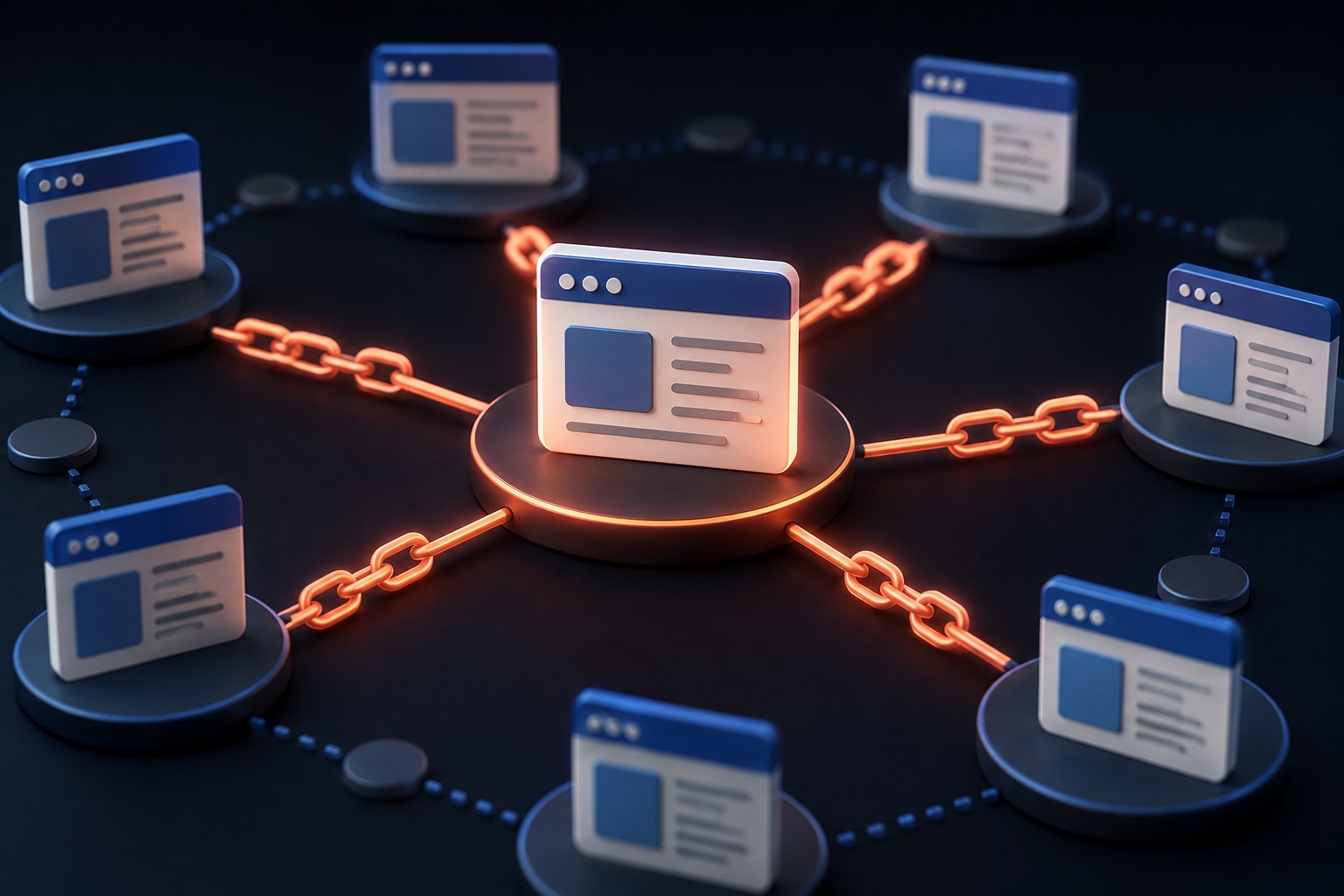

I spent a long time chasing backlinks. Cold emails to site owners, guest post pitches, link exchanges that never quite felt right. Somewhere along the way I realised the links doing the most work for my rankings were not coming from anyone else’s site. They were already sitting inside my own.
Internal linking is now the part of SEO I spend the most time on, for one simple reason: it is the part I can actually control.
What counts as an internal link
An internal link is any hyperlink connecting one page on your site to another page on the same site. A blog post pointing to your pricing page, a product page pointing to a related product, a footer link to your about page. These are the links writers add so readers keep browsing, but search engines read them the same way they read a link coming in from an outside domain.
The difference is that you do not need anyone’s permission to create one. You own every page on both ends of the link, and most sites are sitting on far more unused internal authority than their owners realise.
Why internal links carry so much weight
Two things happen when you add an internal link, and both matter for very different reasons.
Authority transfer
This goes back to the original PageRank concept, where every page on your site is treated as having a certain amount of value, and that value gets passed along through the links pointing to it. A link sitting on your homepage carries more weight than one buried eight pages deep, simply because your homepage usually has the most authority to give away.
Discovery
Search engine crawlers, and increasingly the systems behind AI-generated answers, find new pages by following links. A page with no internal links pointing to it is what the industry calls an orphan page. Google’s Search Advocate John Mueller has put it plainly: if there are no links, Google will not find the URL, whether that page is blocked from indexing or not. An orphan page can technically still sit in your sitemap and get indexed eventually, but it will not get the same crawl attention or ranking support as a page your own site vouches for.
Click depth backs this up with real numbers. Research from earlier this year found that pages sitting four or more clicks from the homepage get crawled roughly 70 percent less often than pages within two clicks. My own rule of thumb is to keep anything I care about within three clicks of the homepage, and I rarely make exceptions.
Put those two effects together and the case becomes hard to argue with. Industry benchmarks from several agencies working on this in 2026 put the impact at a ranking lift of up to 40 percent and a traffic increase of 30 percent or more within a few months, largely from redistributing authority a site already has rather than trying to earn new authority from outside. One estimate suggests around 40 percent of a site’s internal link value gets wasted purely because of orphaned or poorly structured pages sitting unused.
Old content never links forward to new content
Here is a pattern I noticed once I started auditing my own site closely. New content links back to old content constantly. You reference the article that started the conversation, you cite the post that laid the groundwork, you build on what already exists. That happens naturally, without anyone forcing it.
The reverse almost never happens on its own. Older pages do not get revisited to add links pointing to newer content, because that requires someone remembering the old page exists and going back to edit it. Nobody wakes up excited to update a two-year-old blog post just to add a link.
Authority quietly flows backward in time. Your oldest pages keep getting stronger while everything published this year sits there with no internal support at all.
If you want new content to have a fighting chance, updating older pages to link forward has to become part of the publishing process itself, not an afterthought you get to eventually.
This paragraph is a small example of the fix in practice: it originally had nothing pointing forward, and I came back to add a link to The Model Already Has a Favorite, published a month after this one, for exactly the reason described above.
Should you only link where the context fits?
My instinct used to be to link only where it made obvious editorial sense. Link to the pricing page from a pricing article, link to the case study from an article about that client. That approach is not wrong, but it creates a problem I did not see coming.
Your most popular topic keeps accumulating links because there is more content written about it, while topics less central to your site never build the same support. Popular content links to more popular content, and niche pages stay niche indefinitely, not because they are worse, but because the linking pattern never gives them a shot.
The fix is to deliberately widen the net. The best-performing internal linking systems I have seen do not rely purely on contextual relevance. They mix in links connecting concepts semantically rather than by exact keyword match, and some intentionally surface less obvious pages so older or less-linked content gets exposed to crawlers again. It will occasionally look a little odd, a pricing page linking out to a product update from eighteen months ago, but the goal is discovery, not a perfectly tidy editorial trail. Sites testing this on large page counts have reported crawl activity and indexing picking back up within days on pages that had sat untouched for a year or more.
Does this only matter for traditional search?
It is easy to think of internal linking as a leftover from the pre-AI era of SEO. The opposite seems to be true.
AI-driven platforms answering questions directly, whether that is Google’s AI Overviews or a standalone assistant like ChatGPT or Perplexity, still need a way to understand what a page is about and how it relates to everything else on the site. Conductor’s analysis of tens of millions of queries found AI Overviews appearing in roughly a quarter of Google searches at their peak, and separate research from Semrush found visitors arriving through AI-driven search convert at more than four times the rate of traditional organic visitors.
If your internal structure does not clearly connect a page to the rest of your site, an AI system trying to summarise what your site knows has less to work with, the same way a crawler does. I’ve gone deeper into how these systems actually decide what to retrieve and cite in ChatGPT Decides Who to Cite Before It Even Searches and AI Citation Benchmarks, and in both cases, a site with clear internal structure is simply giving the model more to work with.
Where the links live in the code matters
One detail that trips people up: internal links need to be visible in the raw HTML a crawler receives, not just the version a browser renders after JavaScript runs.
If your site is built on a framework that injects links client-side after the page loads, there is a real chance crawlers and AI systems never see those links at all. Rendering links server-side removes that risk entirely, and it is worth confirming with your developers rather than assuming it is already handled.
How to know whether any of this is working
The honest answer is that you check your crawl data before and after.
- Pull a crawl report and count your orphan pages
- Make your structural changes
- Re-crawl and compare the orphan count against your baseline
- Watch
GSCcrawl stats for changes in crawl frequency on previously deep pages
If traffic to older pages starts moving without anyone touching a single word of the content itself, that movement is coming from the structural changes you made. That is one of the more satisfying signals in SEO, because it means you improved something without writing anything new.
The bottom line
Backlinks will always matter, and building them properly is still a real discipline worth investing in. But internal linking is the rare lever that does not require convincing anyone outside your own team, does not cost anything beyond time, and touches almost everything else you are trying to accomplish, from crawl efficiency to topical authority to how well AI systems understand your site.
If you are looking for the highest return on the least effort right now, this is where I would start.