
?utm_source=chatgpt.com
That string is the only reason some of your AI traffic has a name. ChatGPT appends it to links in its search results, and it survives even when a browser or app strips the referrer header that would otherwise say where a visit came from.[1] Between roughly October 9 and October 15, 2026, it went missing.
Cedric Huesler, who works at Adobe, looked at about 500 pages where ChatGPT normally supplied 5% or more of visits. ChatGPT visits had dropped by around 31,000 a day. Direct visits had risen by around 26,000 a day on the same pages, while search was down 7%, the same as everywhere else. “There’s no tag and no referrer,” he wrote, “so your analytics files the visit under direct.”[2] A few days later the tag came back, and he called it a bug.[3]
As far as anyone can tell, nothing about the readers changed that week. The same kind of person clicked the same kind of link, and the dashboard filed them under a different name.
Figure 1. On the same pages in the same week, the visits labelled ChatGPT fell and the visits labelled Direct rose by almost the same amount.
The incident sent me back to an attribution guide I wrote for clients this week, and two sentences in it read worse now. One said a rise in Direct is often a delayed result of organic and AI visibility. The other said zero-click searches had climbed to 68% from about 60% in 2024. Both are defensible. Both carry more confidence than the evidence supports, and the second compares two numbers produced by different panels.[4]
So I went and read the studies behind the headlines, opened the primary source wherever it would open, and asked one question of all of them: what is the most dependable way to know which channels are working when the instrument that counts them is losing signal? I also wanted to know when a falling click count deserves a budget meeting and when it deserves a shrug. I wrote earlier about how ChatGPT decides which brands to cite before it searches; this piece is about what happens after that decision, on the part of the journey your analytics can barely see.
Here is the thesis, stated once so the rest can argue for it:
You cannot count AI search influence, so the job is to triangulate it.
A missing tag turned ChatGPT into Direct for about six days
GA4 added an AI Assistant channel in May 2026. Google defines it as traffic from AI assistants such as ChatGPT, Gemini, DeepSeek, Copilot or Grok, and states that it excludes Google’s AI Overviews and AI Mode, which stay in Organic Search.[5] The channel works from a list of referrers. A session that arrives without a referrer never reaches the list, so it lands in Direct with every bookmark, typed URL and privacy-browser visit.
Referrers go missing in four ways: a site’s referrer policy, rel="noreferrer" on the link, in-app browsers such as WKWebView and Android Custom Tabs, and copy-paste.[6] Which door a visit used decides which label it gets, and the doors change without notice.
Figure 2. The same click gets a different label depending on whether the referrer survives the trip.
| Surface | What GA4 usually shows | Why |
|---|---|---|
| ChatGPT search results in a browser | Named, when the utm_source=chatgpt.com tag is present | The tag survives stripped referrers; it vanished for about six days in October 2026 |
| ChatGPT mobile apps and the Atlas browser | Direct | Referrer stripped in tests run in May 2025 |
| Gemini on the web | Gemini referral | Referrer passes; a utm_source=gemini tag ran for about three weeks in September 2026, then stopped |
| Gemini iOS app | Direct | Opens links in its own WebView with no referrer, per a report |
| Perplexity and Claude.ai on the web | Named | Passed referrers cleanly in the same tests; Perplexity’s apps stripped them |
| Google AI Overviews and AI Mode | Organic Search | Excluded from the AI Assistant channel, so clicks merge with classic results |
Those platform tests are from May 2025, and the Gemini and ChatGPT rows show how quickly the picture moves.[7] In Ahrefs’ own analytics, Copilot traffic disappeared for several months after a single platform change.
How much AI traffic ends up in Direct? Published estimates run from 35% to 70%. The top of that range is 70.6% of 446,405 visits, from Loamly, a vendor that sells attribution tooling, so I treat it as a ceiling that applies to some sites and not as a number for yours.[8] What matters for a decision is the shape of the loss. It concentrates in mobile apps and in-app browsers, which means it also concentrates in the audience most likely to be reading on a phone between meetings.
The loss would matter less if AI visitors were worth little. The best-documented counterexample is one site: Ahrefs reported that AI search drove 0.5% of its traffic and 12.1% of its signups over 30 days, about 23 times the conversion rate of its organic visitors.[9] The author said his own gut suggested the gap would shrink at scale. I take that as the right amount of doubt. A small slice of traffic can carry a large slice of revenue, and it is the slice your tools are most likely to mislabel.
Falling clicks are measured, but every study measures something different
Four studies get quoted most when someone argues that AI answers are eating clicks. They ask different questions of different people over different periods, which is why they produce different numbers.
| Study | What it measured | Finding | What limits it |
|---|---|---|---|
| Pew Research, March 2025: 900 US adults, 68,879 Google searches | Clicks on result pages with and without an AI summary | 8% clicked a result link with a summary, 15% without; 1% clicked a link inside the summary | One month, Google only; summaries appear more often on long questions |
| Ahrefs, Dec 2023 vs Dec 2025: 300,000 keywords | Position-one CTR on keywords with an AI Overview against a forecast | 58% lower than forecast | The authors call it a correlation; the forecast borrows a proxy |
| Agarwal and Sen, Jan to Feb 2026: 1,065 US participants | Randomized: AI Overviews shown or hidden | 0.38 outbound clicks per search with them, 0.61 without | Working paper, not peer reviewed; desktop Chrome users |
| SparkToro, Jan to Apr 2026 | Share of US Google searches ending without a click | 68.01% | The 2024 figure came from a different panel |
Figure 3. Each study shows fewer clicks with an AI summary. The sizes differ because the questions differ.
The first thing the four agree on is direction: where an AI summary appears, fewer people click a result.[10][11] The Pew data adds a gradient that matters later. Summaries appeared on 53% of searches with ten or more words and on 8% of one- or two-word searches, so click erosion starts with long, conversational questions and barely touches short brand queries.[10]
The second thing is easy to miss. In the randomized test, over 95% of participants in the group with AI Overviews hidden did not notice any change, and satisfaction, information quality and ease of finding information came out nearly identical to the control group.[12] People lost the click and kept the answer. Whether that is good news depends on whether the click was how you made money, which no study of search behavior can answer for your business.
Google’s own position is that total organic click volume is “relatively stable” and that it sends slightly more quality clicks than a year earlier. Reporters who asked for supporting data have not been given any.[13] I include the claim for completeness and give it no weight in either direction.
A rise in Direct proves less than I told my clients
The best evidence I found that AI recommendations turn into later visits comes from Similarweb, which tracked thousands of user journeys in finance, travel and beauty. Users asked ChatGPT an industry question and received a brand recommendation. A brand that ChatGPT recommended was 2.5 times more likely to receive a visit within seven days than a brand it did not recommend. About 56% of those AI-influenced visits arrived through search, against roughly 40% of ordinary visits.[14] The recommendation did its work, and the visit showed up as branded search or Direct with no trace of the AI answer that caused it.
That finding supports my original sentence in one direction. It does not license the reverse, because Direct also holds bookmarks, typed URLs, privacy browsers and apps that hide referrers. Patrick Stox’s guidance on AI traffic attribution says a missing referrer is ambiguous and that a rising Direct conversion rate is a reason to investigate, which falls short of proof of hidden AI traffic.[15] Similarweb also sells AI visibility tools, and its study measured people already exposed to a recommendation. I would now write that a rise in Direct may reflect delayed AI and organic influence, and that you can only know by checking it against other evidence.
The sharpest demonstration of what software attribution misses came from asking people. Refine Labs ran a 12-month test in which a mandatory free-text field, “How did you hear about us?”, was added to a strategy-call form and compared with HubSpot’s attribution for each of 620 conversions. Software credited web search with 78% of conversions. Buyers credited it with 12%. Dark social, a bucket covering social, podcasts, word of mouth and community, took 85% of self-reported mentions, and because many answers named more than one source, those percentages are shares of mentions.[16] It is one company’s data, with a free-text field that forced a specific answer. It is also the cleanest comparison of the two instruments I could find.
Figure 4. The software and the buyers told two different stories about the same 620 conversions.
AI visibility trackers report a rank that does not exist
If analytics undercounts the outcome, the next tempting move is to measure the exposure: how often does ChatGPT or Google’s AI name your brand? An entire product category sells that answer as a position, such as “you rank #3 for best CRM for startups.”
SparkToro and Gumshoe.ai tested whether such a position exists. They ran 2,961 prompts across ChatGPT, Claude and Google’s AI, with hundreds of volunteers. In the core test, 12 brand-recommendation prompts ran 60 to 100 times each per platform. ChatGPT and Google’s AI returned the same list of brands less than 1% of the time and the same list in the same order less than 0.1% of the time.[17] Rand Fishkin put it plainly: “If you ask an AI tool for brand/product recommendations a hundred times nearly every response will be unique.”
Visibility held steadier than position. When 142 people wrote their own headphone prompts, producing 994 responses, Bose, Sony, Sennheiser and Apple appeared in 55% to 77% of the responses even though the prompts barely resembled each other.[17] How often you appear across many runs is a usable measurement. Where you appear in any one run changes every time you look. The authors disclosed that Gumshoe sells tracking tools, that the work is not peer reviewed, and that how many runs are enough remains open.[18] I would still ask any visibility vendor how many times each prompt runs and show me the spread before I paid for a number.
Figure 5. Where a brand ranks changes every run; how often it appears across many runs holds up better.
Three bearings and a cocked hat
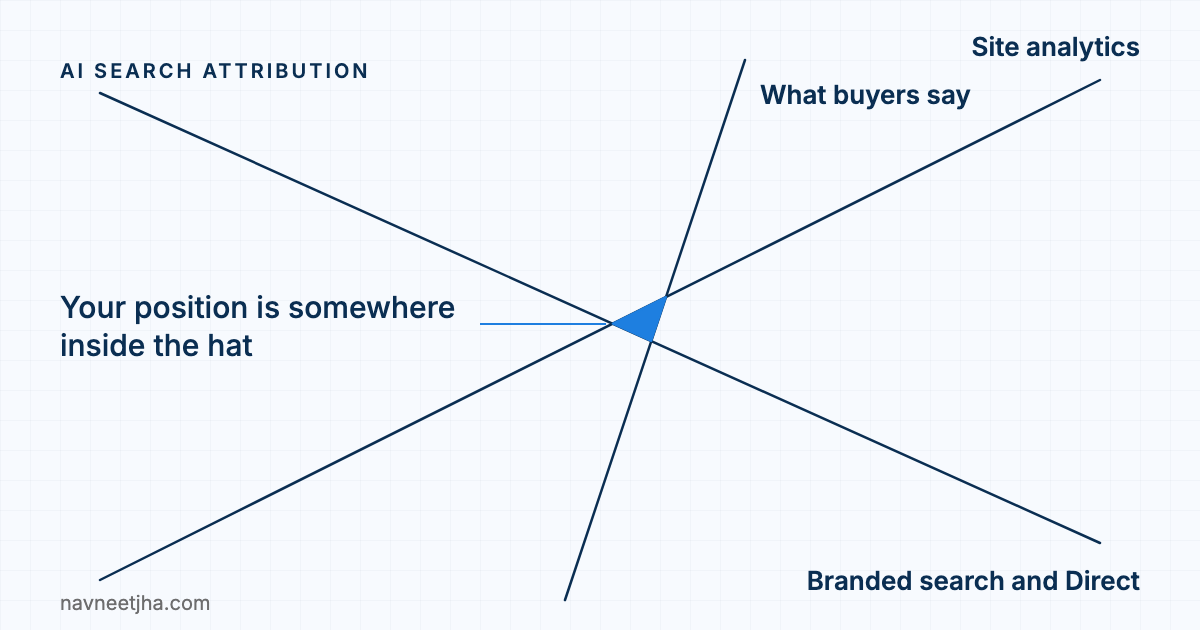
A navigator without GPS takes a compass bearing to a landmark and draws a line on the chart. One line says you are somewhere along it. Take a second bearing to another landmark and the lines cross at a point; take a third and they almost never meet at one point. They form a small triangle that navigators call a cocked hat.[19] Your position lies somewhere inside it, and the size of the hat is the honest measure of how little you know. If the three lines miss each other badly, one instrument is wrong and you go looking for which.
Attribution for AI search works the same way, because no single instrument is reliable enough to trust alone. I use three bearings.
Bearing one: what your own site recorded. This is GA4 configured so it loses as little as possible: a custom channel group with an AI regex placed above Referral (GA4 applies the first rule that matches), UTM tags on every link you control, and key events on the actions that signal buying intent, such as demo requests and form submissions. Write down your Direct volume and Direct conversion rate for the 90 days before you change anything, because every later comparison needs that baseline.[15] This bearing gives you a floor. Whatever it reports happened, and a good deal else happened that it could not see.
Bearing two: what people go looking for afterwards. If the Similarweb pattern holds for your category, AI exposure should surface as branded search. Search Console’s branded queries filter, announced in November 2025, splits Performance data into branded and non-branded; it works only on top-level properties with enough query volume, and Google says its AI-assisted classification can occasionally misidentify queries.[20] Bing Webmaster Tools added an AI Performance report in February 2026 that lists citations, cited pages and grounding queries, though it carries no click data. Google’s Search Generative AI reports, launched June 3, 2026, show impressions inside AI features, and according to third-party descriptions of them no clicks.[21] Treat impressions with care across September 2025, when Google stopped honoring the &num=100 parameter and most sites saw impressions drop for reasons unrelated to demand.[22] Compare clicks for branded queries, or compare periods that both sit after that date.
Bearing three: what buyers say. Put a mandatory open-text “How did you hear about us?” on your highest-intent form. Open text beats a dropdown because people name sources your dropdown never listed, such as “ChatGPT told me” or “a podcast I can’t remember”. Code the answers weekly into five or six buckets. The known weakness is recall: practitioners report that people tend to name their most recent or most memorable contact, and I found no independent study measuring that bias.[23] This is also the bearing The Model Already Has a Favorite runs into from a different angle: if the model already picked a shortlist for your category before your content ever existed, asking buyers directly is often the only way to learn you were on it, since no amount of citation tracking tells you what a buyer actually did with the answer they read.
Figure 6. The three bearings and what each one gives you.
Once the three lines are drawn, the rule is short. When all three point the same way, act. When they disagree, the disagreement is the finding, and you investigate the instrument before you move money.
Every so often you check the instruments against a known landmark, and the only method that tests cause is an experiment. A 2015 Econometrica study switched off eBay’s brand-keyword ads in some regions and kept them on in others. Shoppers who lost the paid link mostly clicked the free result instead, and the ads showed little measurable short-term benefit, and practically none for frequent buyers.[24] The result depends on eBay’s strong organic ranking, so a brand with weaker rankings or bidders on its name could see something different, which is exactly why you run your own test. Google’s open-source Meridian GeoX supports geo experiments such as holdback and go-dark designs and feeds their results into marketing mix models as priors.[25] Smaller teams can use CausalImpact, a method from Google researchers that builds a synthetic control from related time series to estimate what would have happened without an intervention, which suits a pause test on paid brand or a before-and-after on a content launch.[26] An agency write-up puts the floor for a four-week geo holdout around $40,000 per channel per month, a vendor claim that matches my sense of why small budgets should use the time-series route instead.[27]
Which channel earns the next dollar, and which falling click you can afford
Put the three bearings side by side for each channel and the decision mostly makes itself. These rows are the patterns I see most often; they are my own synthesis and not a published standard.[28]
| Clicks and conversions | Branded search and Direct baseline | What buyers say | Call |
|---|---|---|---|
| Down on informational pages | Rising | Name AI and search | Affordable loss; keep investing in the pages AI engines cite |
| Down on pages that convert | Flat or falling | Silent on AI | Worrying; fix those pages first |
| Up on paid brand | Flat | Friends, colleagues, podcasts | Harvesting demand created elsewhere; run a pause test before adding budget |
| Flat | Rising | ”ChatGPT” and “Google AI” appear | AI visibility is working; protect it and add more of what gets cited |
| Up | Rising | Consistent | Spend |
The table says a channel that wins on all three bearings gets the next dollar, and a channel that wins only on bearing one gets a test. The paid brand row is the one I would check first in most accounts, because the eBay experiment is the best-known reason to suspect that, where organic already ranks first for your name, paid brand clicks relabel visits you would have captured for free.
For falling clicks, I ask three questions in order.
- Where did the clicks fall? A loss on definitional and long-question pages that never led to a lead costs less than the chart suggests. The Pew gradient says that is where AI summaries appear most, and the randomized test says users there got their answer and kept their satisfaction.
- What did branded search, Direct and leads do over the same window? If they held or rose, the audience still found you.
- Are you named in the answer? Sample your priority prompts across many runs, read the Bing citation report, and check whether competitors fill the slot you used to fill.
Figure 7. The three questions, in order, for judging whether a falling click is affordable.
Clicks falling on pages with a commercial path, while branded search and leads fall together and the engines name your competitors, is the pattern that should worry you. Clicks falling on informational pages while branded search, leads and mentions hold is a pattern I would accept. The cases in between get a watch list and a date to review. No study I found tests this triage directly, so it is reasoning built on the evidence above and my own read of it.[28]
The strongest objection: this is vibes in a sailor costume
A sceptical CFO can fairly say that three observational signals plus a judgment call is a story with nautical vocabulary. Branded search rises from offline events, a PR spike or a seasonal pattern. Self-reported answers lean on memory. The vendor studies I cited have products to sell. Google insists that clicks are stable and higher quality, and the one randomized test I found covers desktop Chrome users for two weeks. Any of the three bearings can drift together, and when they do the hat looks small and wrong.
The objection is right about all of that, and it still loses to the alternative. Last-click reporting returns a single number with far more precision than its evidence earns. A cocked hat states its uncertainty in its own size, and the three instruments fail in different ways: a stripped referrer does not change what a buyer types into a form, and a vague memory does not change what Search Console counted. When they agree, the odds that all three are wrong in the same direction fall. When they disagree, you learn which one to distrust. Experiments then calibrate the whole set, which is the job the landmark check does.
Back to the tag
Twenty-two characters, utm_source=chatgpt.com, held up a measurable share of what AI engines do for brands, and when the tag disappeared for about six days the dashboard simply reassigned the people. Your analytics are a compass that occasionally loses its markings, and the response is to take more bearings, since rebuying the compass fixes nothing.
Pull your last 90 days. Draw the three lines. If the hat is small, spend. If it is wide, fix the instrument before you move the money.
Want help setting up the three bearings for your own site, or a read on whether your falling clicks are the affordable kind?
Frequently Asked Questions
Can GA4 track AI search traffic?
Partly. GA4 has an AI Assistant channel that classifies sessions from recognised AI referrers, and it excludes Google AI Overviews and AI Mode. Sessions that arrive without a referrer land in Direct, so use a custom channel group, UTM tags and a recorded Direct baseline.
How much AI traffic ends up in Direct?
Published estimates run from 35% to 70%, and the highest figure comes from a vendor. The answer for your site is unknown until you compare your Direct baseline before and after changes.
Are falling clicks from AI Overviews a problem?
It depends on where they fall. Studies agree that clicks drop when an AI summary appears, but a randomized test found satisfaction unchanged. Check branded search, leads and whether the engines name you.
What is the most reliable way to measure AI search impact?
Combine three independent signals (site analytics, branded search and Direct trends, and self-reported attribution) and run an occasional experiment such as a pause test or geo holdout. No single metric holds up alone.
Notes
-
Patrick Stox, “AI Traffic Attribution,” patrickstox.com. His
document.referrertests, run in May 2025, found that ChatGPT Search appendsutm_source=chatgpt.com, so visits remain identifiable when the referrer header is stripped. Platform behavior changes without notice, and the tests predate the October 2026 incident described next. -
Barry Schwartz, “OpenAI drops UTM parameters from ChatGPT results,” Search Engine Roundtable, October 14, 2026, updated October 15. Huesler’s analysis covered about 500 pages where ChatGPT drove at least 5% of visits, comparing October 9 to 13 with the week before. Direct rose on two of every three pages that lost ChatGPT traffic. Sébastien Billard separately reported a ChatGPT traffic drop starting October 9.
-
Per Huesler’s October 15 update, ChatGPT was “tagging its links with utm_source=chatgpt.com again,” and he called the episode “a bug.” His technical explanation was that links opened with
window.openandnoopener,noreferrer, which drops both tag and referrer. The coverage I found quotes no OpenAI statement, so the cause rests on his analysis. -
The 68.01% figure covers January to April 2026 and rests on Similarweb clickstream data, per Techwyse’s report of SparkToro’s study. The 2024 comparison figure of 60.45% came from earlier SparkToro research on a different data provider, and the reporting itself says the long-term comparison is “not directly equivalent.” I could not open SparkToro’s own post (the server returned a 403), so I rely on secondary coverage. The honest summary is that zero-click searches are high and probably rising, and the exact size of the rise is unknown.
-
Google Analytics Help, “Default channel group.” The page defines the channel through the medium
ai-assistantand a referrer list, and states that it excludes Google’s AI Overviews and AI Mode. It gives no launch date. I take May 13, 2026 from Stox’s write-up and have not seen Google confirm it. Stox also notes the channel is not retroactive and does not capture sessions without a referrer. -
The four mechanisms are listed in Stox’s article, which reports that WKWebView and Android Custom Tabs drop the referrer. The same article notes Copilot traffic vanishing from Ahrefs’ analytics for months after a platform change.
-
Table sources: Stox’s May 2025 platform tests; Barry Schwartz, “Google Gemini stopped attaching UTM parameters to cited URLs,” Search Engine Roundtable, October 30, 2026. Natzir tracked the
utm_source=geminitag, which grew for roughly three weeks from early September and vanished around September 28. On the iOS app, Natzir wrote that it opens links in its own WebView and sends no referrer. John Mueller said he saw the tags about a month earlier. -
Stox’s article gives a range of 35% to 70% for AI-sourced visits landing in Direct and labels the Loamly figure (70.6% of 446,405 visits) vendor-sourced. Loamly also reports that dark AI visits convert at 10.21% against 2.46% for true Direct, which I do not use because it comes from the same vendor and I could not trace the method.
-
Patrick Stox, “Does AI Search Traffic Convert Better Than Traditional Search? For Ahrefs, Yes,” Ahrefs, June 16, 2025. The 0.5% and 12.1% figures cover 30 days on Ahrefs Web Analytics, and ChatGPT supplied most of the signups. The author said a multi-site study was still in progress and that his gut told him the gap “won’t be quite that good” at scale. Engagement was mixed: bounce rate and pages per visit were higher and visit duration was shorter.
-
Pew Research Center, “Google users are less likely to click on links when an AI summary appears in the results,” July 22, 2025. Sample: 900 US adults in an app-tracked panel, March 2025, with results re-collected in April, so the summary a user saw may differ from the one captured. About 18% of the 68,879 searches produced a summary. Sessions ended after 26% of visits to pages with a summary against 16% without. Pew did not say whether the comparison controlled for query type, and summaries appear far more often on long questions, so some of the gap may reflect what people searched for.
-
Ahrefs, “AI Overviews Reduce Clicks,” updated 2026. The authors scaled position-one CTR on AI Overview keywords from December 2023 (0.073) by the decline for informational keywords without AI Overviews (0.076 to 0.039), forecasting about 0.037. The actual December 2025 figure was about 0.016. The gap is the 58%. The authors describe it as a correlation, and the forecast assumes informational keywords without AI Overviews are a fair proxy for those with them.
-
Saharsh Agarwal and Ananya Sen, SSRN working paper, April 2026, as summarized by Search Engine Journal. Participants came from Prolific with desktop Chrome, and a browser extension hid AI Overviews in real time for one arm. AI Overviews appeared on 42% of queries. Zero-click searches rose from 54% to 72% when they were shown, and sponsored clicks stayed steady. The authors call the results exploratory and cite higher attrition, and the paper is not peer reviewed. The AI Mode arm showed lower outbound clicks and lower satisfaction.
-
Liz Reid, Google blog, August 6, 2025, stating that total organic click volume is “relatively stable year-over-year” and that Google sends “slightly more quality clicks.” Search Engine Journal and others noted that Google had not published supporting data. I gave the claim no weight because it cannot be checked, which is a different judgment from calling it false.
-
Similarweb, “Being Recommended in AI Makes Users 2.5x More Likely to Visit Your Site,” June 23, 2026. The company tracked thousands of journeys, excluded users who had recently visited the brand or named it in the prompt, and followed each for seven days. It did not publish an exact sample size or per-vertical numbers in the article. Secondary coverage describes the data as US desktop users, July to December 2025. Similarweb itself calls the measurement “not an exact science.” The design compares recommended brands with unrecommended ones among users who were exposed, so it shows association in that group and says nothing about people who never asked.
-
Stox’s recommended method: baseline Direct before making changes, build a custom AI channel group above Referral, segment AI traffic in Explorations, and triangulate with branded-search trends, Direct baseline shifts and post-conversion surveys. His caveat that a rising Direct conversion rate “is a reason to investigate” paraphrases his caution that attributed conversions reflect configured credit assignment and prove no causation.
-
Megan Bowen, “The Attribution Mirage,” Refine Labs, October 15, 2024, describing a 2023 analysis of 620 conversions over 12 months. The article does not call the HubSpot model last-touch, so I avoid the label. Self-reported percentages are shares of mentions, and answers often named several sources. One company’s results, from a form that forced a free-text answer, can look different in another market.
-
Rand Fishkin and Patrick O’Donnell, SparkToro and Gumshoe.ai study, as reported by Search Engine Journal. Platforms were ChatGPT, Claude and Google’s AI (AI Mode where Overviews did not appear). The repeat figures cover the 12-prompt core test. Claude repeated lists slightly more often and repeated order less often. Visibility percentages were steadier than rank, and in tight categories such as cloud computing the top brands appeared in most responses, while broad categories such as science fiction novels scattered more.
-
Disclosures: Gumshoe.ai sells AI tracking tools, Fishkin disclosed the partnership and said he started out expecting tracking to prove pointless, the study is not peer reviewed, respondents used their usual AI settings without standardization, and open questions include how many runs are enough and whether API calls vary like manual prompts. The authors published the methodology and raw data on a public mini-site.
-
Navigators use “cocked hat” for the triangle formed when three lines of position fail to meet at a point, named for its shape. I like that the discipline that gave us “dead reckoning” also named its error region after headwear. The analogy illustrates how to combine imperfect evidence and proves nothing about marketing. The evidence is in the studies above.
-
Google Search Central, “Introducing the branded queries filter in Search Console,” November 20, 2025. Eligibility: top-level properties with sufficient query and impression volume, and the rollout reached all eligible sites by a March 11, 2026 update. Google classifies queries with an AI-assisted system, says some may occasionally be misidentified, and states that the filter has no effect on ranking.
-
Bing: Microsoft’s AI Performance report in Bing Webmaster Tools launched as a public preview in February 2026, per agency write-ups, with citation counts, cited pages and grounding queries and no click data. Google: the Search Central post of June 3, 2026 announced Search Generative AI performance reports. Third-party descriptions say the Search report shows impressions only, with clicks from AI features still counted in the main Performance report. I did not open Google’s page in full, so check current Search Console documentation before relying on this.
-
Multiple analyses reported that Google stopped honoring
&num=100around September 10 to 12, 2025, which removed impressions from rank trackers and crawlers. One analysis of 319 properties found 87.7% saw an impression drop. These are secondary sources and I found no measured clicks comparison, so “clicks were unaffected” is an inference from commentary, which means you should check your own click data. -
The case for open text over a dropdown, and the recency-bias warning, come from practitioner sources including Blend B2B and Dreamdata. I found no independent study comparing self-reported and software attribution, so Refine Labs’ single-company test carries more weight in this essay than it should and I flagged it as such.
-
Thomas Blake, Chris Nosko and Steven Tadelis, “Consumer Heterogeneity and Paid Search Effectiveness: A Large-Scale Field Experiment,” Econometrica, 2015. Brand-keyword ads were paused in some regions, and most would-be clickers used the organic link instead. Follow-up work suggests results depend on market position, including an Edmunds.com study by Coviello, Gneezy and Goette (2017) that I know only through secondary descriptions.
-
Google, “Meridian GeoX.” The page describes an open-source incrementality solution supporting holdback, go-dark and heavy-up designs and states that results convert into priors that calibrate Meridian MMM results. It gives no release date.
-
Kay Brodersen, Fabian Gallusser, Jim Koehler, Nicolas Remy and Steven Scott, “Inferring causal impact using Bayesian structural time-series models,” Annals of Applied Statistics 9(1), 2015, pp. 247 to 274. CRAN’s package page lists the year as 2014, while the journal record says 2015.
-
Elevarus, “Incrementality testing agencies spend tier framework.” It is an agency claim and not an established benchmark, and I include it as a rough signal of why small budgets struggle to reach significance with geo holdouts.
-
This triage table and the three-question order are my own synthesis from the studies above. Nobody has published a test of this specific decision rule. Where I say a loss “costs less than the chart suggests,” that inference is mine, built from Pew’s query-length gradient and the randomized test’s satisfaction results. It leans on one working paper and one panel study, so run your own checks before cutting anything.